Alpkit Possum frame bag review: four years of silent service
In-depth 4-year review of the Alpkit Possum half-frame bag. Real-world durability, what fits, knee rub clearance, shock cord hack, and new upgrades.
Whenever cyclists gather at a cafe stop or chat around a camp stove, everyone tends to drool over the shiny, headline-grabbing kit. Featherweight titanium mugs, fancy dynamos, ultralight tents, or carbon wheelsets get all the limelight.
Then there is that quiet category of gear that never gets bragged about. It doesn't scream for attention. It simply gets bolted onto the bike, does an immaculate job day in and day out, blends into the frame, and gets completely taken for granted.
For me, that unsung hero is the Alpkit Possum.
I've had this half-frame bag strapped inside the front triangle of my Sonder Camino for roughly four years. It has lived on my bike practically non-stop: through daily commutes, sodden winter gravel grinds across Dorset, quick overnighters like my 2-day Dartmoor bikepacking trip, and multi-day tours catching cross-channel ferries.
Four years is a proper shift for any cycling bag. Here is how it has held up, the one simple mounting tweak I made on day one, and how Alpkit has recently updated the design.

Quick verdict: is the Alpkit Possum worth it?
If you are skimming for the bottom line before diving into four years of trail abuse, here is my direct takeaway:
- Best for: Gravel riders, commuters, and bikepackers who want to carry heavy essentials low on the bike without sacrificing their bottle cages.
- Price: ~£93 RRP (frequently on sale around £65)
- Capacity options: 2.6L (Size 42), 3.5L (Size 47), 4.4L (Size 52)
- Weight: ~170g to 210g
- Pros: Outstanding zip longevity, zero knee rub, clever right-side phone pocket, leaves room for two bottles, excellent value compared to £100+ competitors.
- Cons: Stitched seams can allow minor moisture ingress in howling crosswind storms, printed logo peels after prolonged trail grit, stock Velcro straps can look slightly slack without tensioning.
The "soggy bag" dilemma and my shock cord fix
When I first took the Possum out of its packaging four years ago, I attached it using the supplied Velcro straps. It fit the frame geometry of my Camino nicely, but there was one small visual gripe that bugged me: with just the Velcro straps, the top edge looked kinda soggy.
It dipped between the attachment points, giving the bag a slightly slack, droopy posture along the top tube. Not a dealbreaker functionally, but it definitely triggered my cycling neatness OCD haha.
So, very early on, I tried something different.

I grabbed a length of thin elastic shock cord (bungee line) and laced it continuously through the daisy-chain webbing loops along the top edge of the bag, wrapping it neatly around the top tube in an even spiral.
The difference was instant. The elastic pulls the fabric uniformly tight along the entire tube length. No sagging, no bunching, and no floppy fabric when the bag is half-empty. It holds tension even when riding rough bridleways, and it takes zero effort to adjust. I loved it so much that I've never gone back to standard top straps since.
What actually lives inside?
A half-frame bag hits the sweet spot for bike geometry. Unlike a full-frame bag that hogs the entire inner triangle, the Possum leaves ample clearance underneath for two standard water bottles in their cages. That alone makes it practical enough to leave on the bike 365 days a year.


Everyday commuting & gravel rides
On daily spins, the main compartment on the left holds the heavy, dense essentials that would otherwise weigh down jersey pockets or rattle in a backpack:
- Compact hand pump
- Spare gravel inner tube
- Multitool with chain breaker
- Tyre levers and tubeless tyre repair plugs
- Compact cable lock (for quick bakery stops)
Bikepacking & overnighters
When packing for weekend bikepacking loops (check out my complete bikepacking checklist and packing list), the bag gets crammed to full capacity. Because weight inside the frame bag sits close to the bike's centre of gravity, it handles heavy items better than a handlebar roll or a tail pack:
- Small 100g gas canister and BRS-3000T ultralight mini stove
- Bags of porridge, flapjacks, and nuts
- Spare battery bank and charging leads
- High-density snacks for long stretches between resupply stops

The right-hand stash pocket: a phone and wallet haven
One feature that deserves special mention is the flat pocket on the right-hand (drive) side of the bag.
It is completely separate from the cavernous main compartment. Because it is flat and sits flush against the frame, it is the absolute perfect spot for your phone, wallet, contactless card, and cafe keys. You don't have to go digging past oily tools or dirty inner tubes just to grab your phone for a quick trail photo or pay for a flat white.

Does the Alpkit Possum rub your knees when pedalling?
One of the biggest questions people ask before buying any frame bag is: will it brush against my knees while pedalling?
There is nothing more irritating on a 60-mile gravel grind than your inner thigh or knee constantly grazing a bulging bag on every pedal revolution.
With the Possum, knee rub has been a total non-issue. The bag has a slender profile that tapers from around 10cm at the head tube down to 4cm to 5cm near the seat tube. Crucially, the side panels have enough vertical tension that the bag does not balloon outwards into a round barrel, even when you pack it full of snacks. Your knees pass by cleanly, whether you are spinning in the saddle or grinding up steep gravel climbs on your feet.
Half-frame vs full-frame bag: which is right for you?
When setting up a gravel or bikepacking bike, choosing between a half-frame bag and a full-frame bag comes down to one main factor: hydration.
- Choose a full-frame bag if: You are tackling remote desert routes or self-supported endurance races where you need 8 to 14 litres of internal storage and plan to run a 3-litre water bladder with a hose clipped to your cockpit.
- Choose a half-frame bag (like the Possum) if: You want a versatile, everyday setup. A half-frame bag lets you keep two standard bottle cages mounted on your frame tubes. Drinking from bottles on the fly is simpler, refilling at village taps is quicker, and the bag can live permanently on your bike without getting in the way of commuting or weekend club runs.
For 90% of UK riding and European bikepacking, a half-frame bag paired with a seat pack and bar roll offers the ideal balance.
Durability: what survived and what gave up
After four years of regular use in all seasons, the Possum has seen its fair share of grime, grit, puddle baths, and salty sea air.
The zips: completely bulletproof
Zippers are almost always the first point of failure on frame bags. Between grit grinding into the tracks and bikepackers cramming that extra jacket into the main compartment, zip teeth take immense punishment.
On my Possum, the water-resistant zips haven't skipped a beat. No split tracks, no sticking, and no worn teeth, even on trips where I definitely pushed the capacity past its polite limit. The fabric pulls and garages are still in great working order.
The one and only casualty: the peeling logo
The sole bit of damage across four solid years? The heat-pressed white "ALPKIT" logo on the side eventually peeled off, leaving just the faint ghostly silhouette of the lettering on the face fabric.
Honestly, if that's the worst malfunction you experience after four years of non-stop riding, I wish every other bit of cycling kit failed like that! The seams, stitching, and fabrics remain 100% sound.
Weather resistance: showers vs howling storms
Alpkit bills the Possum as weatherproof. In realistic UK riding conditions, it does a stellar job. Normal downpours, relentless drizzle, road spray, and thick Dorset mud flicking up off the front wheel haven't penetrated the bag. Everything inside stays dry and clean.
There is one caveat: the bag is constructed with stitched seams rather than ultrasonic welded fabric. If you find yourself caught in the middle of a vicious storm with ferocious crosswinds driving sheets of rain directly against the side of the bag for hours, a few drops of water can work their way through the needle holes.
It's not a flaw, just the reality of stitched luggage. If you're heading into atrocious weather, keeping your electronics or down jacket in a tiny dry bag or ziplock inside the pocket is cheap insurance.
What has Alpkit upgraded on the latest version?
Looking at the current version on the Alpkit website, they haven't rested on their laurels. The team at their UK factory in Nottinghamshire has made several clever refinements to the current Possum.
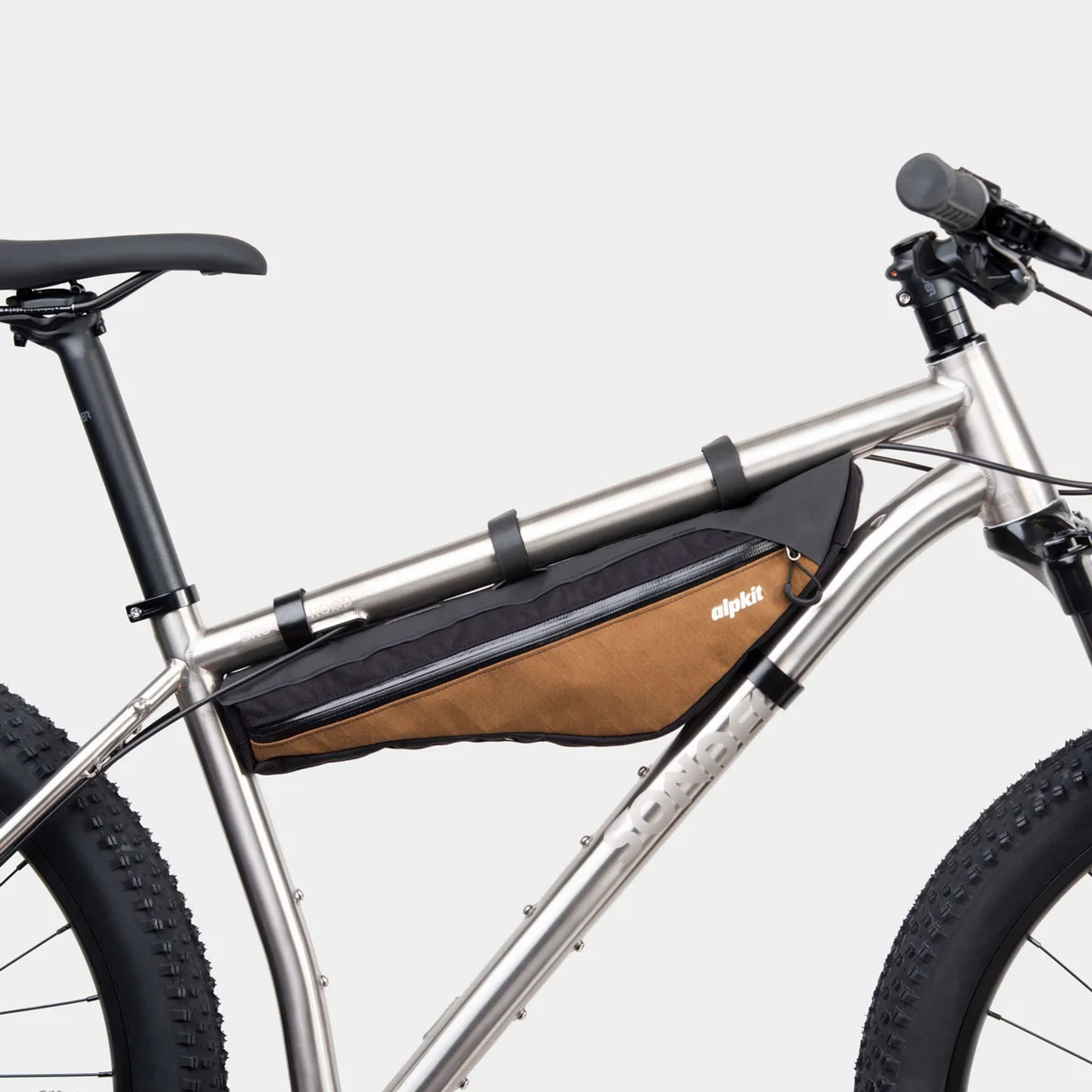
Here are the key improvements Alpkit baked into the new model:
- Internal tent pole loops: Anyone who has carried a tent on a bike knows tent poles are awkward. They are stiff, straight, and don't fit into roll-top seat packs. The new Possum includes dedicated hypalon loops along the inside ceiling to lash your poles out of the way. That is a massive quality-of-life win for wild campers.
- Concealed front cable port: There is now a neat, weather-shielded cable port right at the nose of the bag. You can route a dynamo hub wire inside to charge a cache battery, or run a charging lead from a power bank inside the bag straight up to your GPS or front handlebar light.
- Refined zipper shrouds & pullers: The zips use updated water-resistant YKK AquaGuard closures with low-profile zip garages and chunky pull loops that are easy to operate with thick winter gloves.
- Updated fabrics: Alpkit now crafts these using tough 500D Cordura nylon paired with technical multi-layer laminates (including eco-friendly X-Pac variants), backed by their standard 25-year Alpine Bond warranty.
Alpkit Possum vs alternatives (Restrap, Ortlieb, Apidura)
How does the Possum stack up against other popular gravel and bikepacking frame bags on the market?
- Restrap Frame Bag (£75 - £90): Another fantastic UK-made option built in Yorkshire with 1000D Cordura. Restrap bags are tough as nails, but they are slightly heavier and command a higher price tag.
- Ortlieb Frame-Pack RC (£115+): Ortlieb uses high-frequency welded seams and roll-top closures that are 100% waterproof (IP64 rated). If you ride through monsoons regularly, Ortlieb is hard to beat, but the fabric is stiffer, the look is very industrial, and it costs nearly double the Possum.
- Apidura Expedition Half Frame Bag (£100+): Ultra-sleek, welded construction with lightweight technical laminate. Apidura makes premium gear, but at more than £100, the value proposition drops compared to Alpkit's Possum (especially when picked up on sale around £65 instead of its standard ~£93 RRP).
For everyday reliability, repairability, and realistic British conditions, the Possum strikes the best sweet spot of price to performance.
Alpkit Possum specs & sizing breakdown
The Possum is available in three sizes based on the length of your bike's top tube. Before buying, grab a tape measure and check the internal triangle of your frame:
| Spec / Size | Size 42 (Small) | Size 47 (Medium) | Size 52 (Large) |
|---|---|---|---|
| Top tube length | 42 cm | 47 cm | 52 cm |
| Front depth | 10 cm | 11 cm | 13 cm |
| Rear depth | 4 cm | 5 cm | 6.5 cm |
| Capacity | 2.6 Litres | 3.5 Litres | 4.4 Litres |
| Weight | ~170 g | ~190 g | ~210 g |
| Price | ~£93 RRP (sale ~£65) | ~£93 RRP (sale ~£65) | ~£93 RRP (sale ~£65) |
Worth adding to your rig?
If you are looking for a flash piece of kit to show off on social media, a frame bag probably isn't it. But if you want a reliable, hard-wearing workhorse that swallows all your heavy tools, leaves room for water bottles, and stays on your bike for years without making a fuss, the Alpkit Possum is hard to beat.
At an RRP of around £93 (and a total bargain if you catch it on one of Alpkit's regular sales down near £65), backed by their 25-year warranty, it remains one of the best value investments in British bikepacking gear.
For full details, current fabric colourways, and frame sizing templates, check out the Alpkit Possum product page on alpkit.com.
Happy riding, and go give your frame triangle some love!